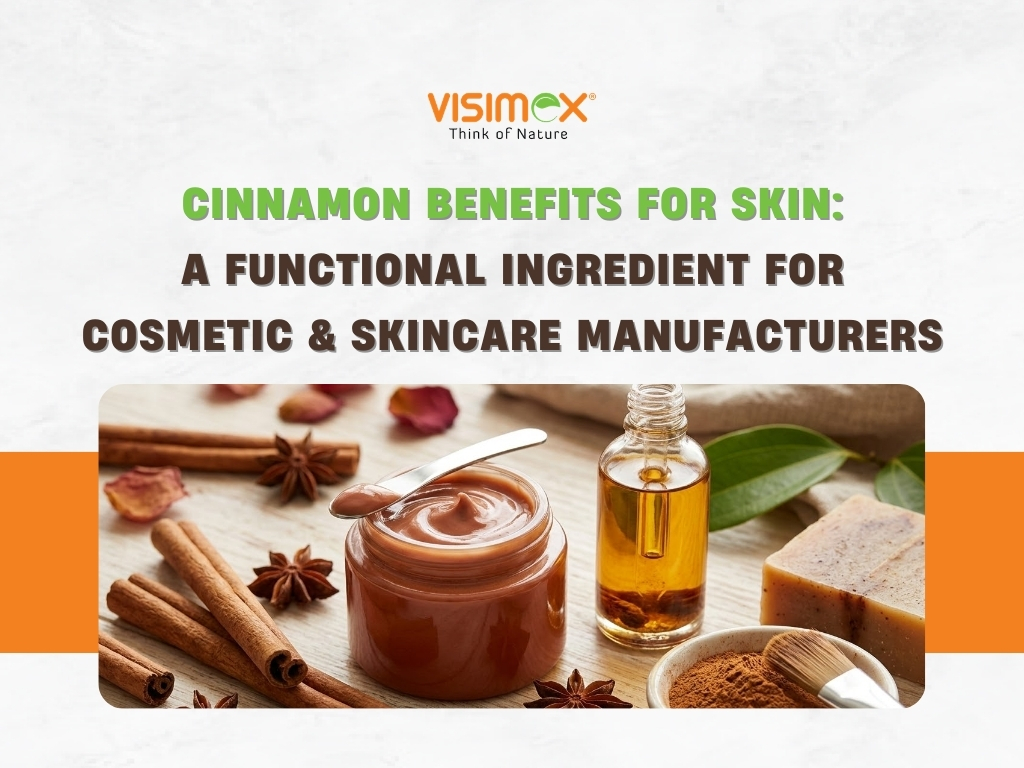


The global beauty industry is rapidly shifting toward plant-based, traceable, and multifunctional ingredients. As brands compete in an increasingly saturated marketplace shaped by clean beauty expectations and sustainability standards, demand for high-performance botanical actives continues to rise. Among these emerging natural ingredients, cinnamon benefits for skin are gaining strong attention from cosmetic formulators, private label brands, and raw material importers worldwide.
This article examines the scientific rationale, formulation applications, regulatory considerations, and commercial potential of cinnamon as a strategic cosmetic ingredient for global B2B buyers.

1. The Growing Demand for Botanical Actives in Skincare Manufacturing
1.1. Clean Beauty and Ingredient Transparency
Consumers increasingly demand transparency, plant-based ingredients, and traceable supply chains. Botanical actives are among the fastest-growing categories in skincare innovation, particularly in North America and Europe.
As a result, brands are under increasing pressure to reformulate products while maintaining both performance and credibility.
For manufacturers, this means:
+ Replacing synthetic additives with natural alternatives
+ Strengthening ingredient traceability
+ Aligning with sustainability commitments
In this context, positioning products around cinnamon benefits for skin not only supports clean-label claims but also enhances brand trust in competitive markets.
1.2. Multi-Functional Ingredients and Cost Efficiency

Modern formulation strategy prioritizes ingredients that deliver multiple benefits within a single system. Cinnamon contains bioactive compounds such as cinnamaldehyde and polyphenols, contributing:
+ Antioxidant protection
+ Antibacterial support
+ Circulation-enhancing properties
Moreover, this multifunctionality allows manufacturers to simplify formulations without compromising efficacy.
For B2B manufacturers, this improves cost efficiency and reduces formulation complexity.
At the same time, it supports faster product development cycles and scalable production.
2. Cinnamon Benefits for Skin in Cosmetic Formulation
Understanding the technical foundation of cinnamon benefits for skin allows manufacturers to unlock its full potential in product development.
More importantly, it helps bridge the gap between natural positioning and measurable performance outcomes.

2.1. Antioxidant Protection Against Oxidative Stress
Oxidative stress accelerates visible skin aging. Cinnamon’s rich polyphenol content helps neutralize free radicals that contribute to:
+ Fine lines
+ Loss of elasticity
+ Dull complexion
Consequently, incorporating cinnamon extract into formulations can strengthen overall antioxidant systems.
In anti-aging formulations, cinnamon extract can enhance antioxidant systems alongside vitamin C, botanical oils, and peptides.
This creates a more comprehensive defense against environmental stressors.
2.2. Antibacterial Support for Acne-Prone Skin
One of the most commercially relevant cinnamon benefits for skin is its antibacterial activity. Cinnamon may help reduce microorganisms associated with acne-prone skin.
Therefore, it becomes a valuable ingredient in formulations targeting both prevention and maintenance.
This makes it suitable for:
+ Acne control cleansers
+ Oily skin treatments
+ Herbal spot-care products
In addition, its natural origin supports clean beauty positioning while maintaining functional performance.
2.3. Microcirculation and Skin Revitalization

Cinnamon’s warming characteristics may stimulate superficial blood flow when carefully formulated.
As a result, it contributes not only to functional benefits but also to sensory experience.
This effect can:
+ Promote a natural glow
+ Enhance revitalizing masks
+ Support energizing skincare lines
Such dual functionality—performance and sensorial appeal—adds significant value in premium and spa-inspired product lines.
2.4. Anti-Aging System Support
While cinnamon is not a direct collagen stimulator, its antioxidant properties help protect collagen from oxidative damage.
In other words, it plays a supportive role in preserving skin structure over time.
This reinforces its role in:
+ Firming creams
+ Preventive anti-aging serums
+ Botanical rejuvenation systems
For brands targeting long-term skin health, this type of support is often more sustainable than aggressive actives.

3. Forms of Cinnamon Used in Cosmetic Manufacturing
Selecting the appropriate form of cinnamon plays a critical role in ensuring product safety, formulation stability, and overall efficacy. Therefore, this choice goes beyond a purely technical decision—it directly influences product performance, scalability, and regulatory compliance.
3.1 Cinnamon Powder
Cinnamon powder is commonly used in rinse-off formulations, particularly in products designed to deliver a natural and sensory experience. Its physical texture makes it suitable for exfoliating scrubs, facial masks, and herbal treatments where gentle mechanical action is desired.
In addition to its functional role, cinnamon powder also enhances the “natural” perception of a product, which is increasingly important in clean beauty positioning.
However, manufacturers must carefully control particle size and dispersion. As a result, quality control at the raw material stage becomes essential when working with powder-based applications.

3.2 Cinnamon Extract
Cinnamon extract is widely preferred in modern cosmetic formulations due to its consistency and formulation flexibility. Unlike raw powder, standardized extracts allow manufacturers to precisely control the concentration of active compounds, ensuring predictable performance across batches.
This level of control significantly improves formulation stability and makes extracts more suitable for scalable production. As a result, they are commonly incorporated into leave-on products such as creams, lotions, and serums, where stability and uniformity are critical.
Moreover, extracts integrate more seamlessly into complex formulations, allowing developers to combine cinnamon with other active ingredients without compromising product integrity.
3.3 Cinnamon Essential Oil
Cinnamon essential oil represents the most concentrated form of cinnamon used in cosmetics. Because of its potency, it delivers strong sensory and functional effects, particularly in formulations focused on stimulation, revitalization, or aromatherapy experiences.
However, this high concentration also requires careful handling. Even small variations in dosage can significantly impact both safety and performance. Therefore, manufacturers must strictly follow international safety guidelines and ensure proper dilution during formulation.
In addition, compliance with allergen labeling requirements is essential. When used correctly, however, cinnamon essential oil can add a distinctive sensory dimension that enhances both product experience and brand differentiation.

4. Safety and Regulatory Considerations
Ensuring safety and regulatory compliance is a fundamental requirement when incorporating cinnamon into cosmetic formulations. Beyond formulation performance, these factors directly affect market access, brand credibility, and long-term business sustainability.
4.1 Ceylon vs. Cassia Cinnamon
One of the key considerations is the type of cinnamon used. Cinnamomum verum, commonly known as Ceylon cinnamon, typically contains lower levels of coumarin compared to Cassia cinnamon.
Because coumarin content is closely monitored in many markets, this difference becomes particularly important for regulatory compliance. For this reason, Ceylon cinnamon is often preferred in cosmetic applications, especially in regions with stricter safety standards such as the European Union.
4.2 Compliance with International Standards

Manufacturers must align their formulations with internationally recognized regulations, including IFRA standards, EU Cosmetic Regulation, and FDA labeling requirements.
However, compliance is not a one-time process. It requires continuous monitoring, documentation, and validation throughout the product lifecycle.
Consistent safety assessments, accurate labeling, and full transparency regarding allergen content are essential. These practices not only protect consumers but also help brands maintain trust and credibility in highly competitive global markets.
4.3 Traceability and Sustainable Sourcing
In today’s cosmetic industry, sourcing is no longer just an operational concern—it has become a strategic priority. Global buyers increasingly expect full traceability, from raw material origin to final processing stages.
In addition, certifications such as organic standards and responsible farming practices are gaining importance. Partnering with vertically integrated suppliers helps reduce risks related to quality inconsistency, supply disruption, and regulatory non-compliance.
Ultimately, reliable sourcing not only ensures product quality but also strengthens ESG positioning and long-term competitiveness in the global market.
5. Commercial Value for Cosmetic Manufacturers
The strategic impact of cinnamon benefits for skin extends beyond formulation performance.

5.1 Market Differentiation
In increasingly saturated beauty markets, differentiation has become more challenging than ever. As consumers shift toward clean and botanical formulations, ingredients with a strong natural narrative gain a clear advantage.
Cinnamon stands out not only for its functional benefits but also for its sensory appeal and cultural heritage. Its warm, recognizable profile allows brands to build more engaging product stories, especially in clean beauty, herbal, and wellness-focused collections.
As a result, cinnamon helps brands create a more distinctive identity without relying solely on complex or unfamiliar actives.
5.2 Cost-Effective Botanical Active
From a formulation perspective, cinnamon offers a strong balance between performance and cost. Compared to certain synthetic actives, it delivers antioxidant and antibacterial support with relatively favorable sourcing economics.
Moreover, its multifunctional nature allows manufacturers to reduce the number of ingredients required in a formulation, which can simplify production and lower overall costs.
This efficiency is particularly valuable for private label brands and large-scale manufacturers looking to optimize both formulation and pricing strategies.
5.3 Portfolio Versatility

Another key advantage of cinnamon is its versatility across product categories. It can be integrated into a wide range of applications, from facial skincare to body care and spa-inspired product lines.
Rather than being limited to a single use case, cinnamon adapts well to different formulation concepts and market segments.
This flexibility allows manufacturers to use one core ingredient across multiple SKUs, improving consistency while maximizing return on ingredient investment. Over time, this contributes to a more streamlined and scalable product portfolio.
6. Vietnamese Cinnamon as a Strategic Sourcing Advantage
Vietnam is one of the world’s leading cinnamon producers, recognized for high oil content and strong aromatic profile.
For cosmetic manufacturers, Vietnamese cinnamon provides:
– Consistent large-scale supply
– Competitive pricing structures
– International certifications
– Expanding organic production capacity
Reliable sourcing partnerships ensure stable quality, traceability, and long-term supply security — critical factors in global B2B procurement strategy.
7. Conclusion: A Scalable Botanical Solution for Modern Skincare
As the beauty industry continues evolving toward natural, multifunctional, and sustainable ingredients, cinnamon benefits for skin offer measurable technical and commercial advantages.
From antioxidant defense and antibacterial support to revitalizing sensory appeal, cinnamon stands out as a scalable botanical solution for cosmetic and skincare manufacturers seeking performance, differentiation, and supply chain reliability.
When responsibly sourced and professionally formulated, cinnamon becomes more than a traditional spice — it becomes a strategic ingredient in next-generation skincare innovation.
Visimex – Pioneering the Journey of Vietnamese Cinnamon to the World
As a leading cinnamon exporter in Vietnam, Visimex has partnered with farmers for over 23 years, building a fully integrated supply chain from raw material sourcing to processing. Visimex cinnamon products meet international certifications including EU Organic, USDA Organic, BRC, and Halal, ensuring the highest standards for global markets.

Beyond exports, Visimex pursues sustainable development, emphasizing social and environmental responsibility, and aims to elevate the value of Vietnamese cinnamon on the global agricultural map. With the vision “Think of Nature,” Visimex continues to play a pioneering role in bringing Vietnamese agricultural products to the world, strengthening Vietnam’s top position in the global cinnamon industry.
Contact Information:
Address: NIC GROUP Building, No. 3A Thi Sach, Hai Ba Trung, Hanoi
Website: https://Visimex.com
Email: sales@Visimex.com
Phone: (+84) 989 255 988 | (+84) 90 456 1155
LinkedIn: https://www.linkedin.com/company/Visimexcorp